Economics of Credit Acceptance

Credit Acceptance (NASDAQ: CACC) is an auto finance company that provides used-car loans to primarily subprime borrowers. Credit Acceptance’s business model deviates from the industry norm of buying loans originated from a dealer at a modest discount (although CACC does practice this under their “Purchase Loan” program). Instead, Credit Acceptance’s main focus is their Portfolio Program, where they act as an indirect lender (legally) by partnering with dealers to make the loans. Credit Acceptance sends the dealer an advance for anticipated future collections of the consumer loan. The dealer also receives a down payment from the consumer on the loan. CACC then receives 100% of the cash flow from the loan up until the amount equals that of the advance sent by CACC to the dealer plus some profit (130% of the advance – profit is called the servicing fee). After receiving the full balance, CACC and the dealer split the cash flows, typically 80-20 (20% for CACC). This works for both the dealer and CACC due to the potential profit to be made from successful consumer loans.

Credit Acceptance has been using this model for well over 20 years now without fail. The result from its operations have compounded diluted earnings per share at 24.9% over the past 20 years as well as an average return on equity of 28.7%.
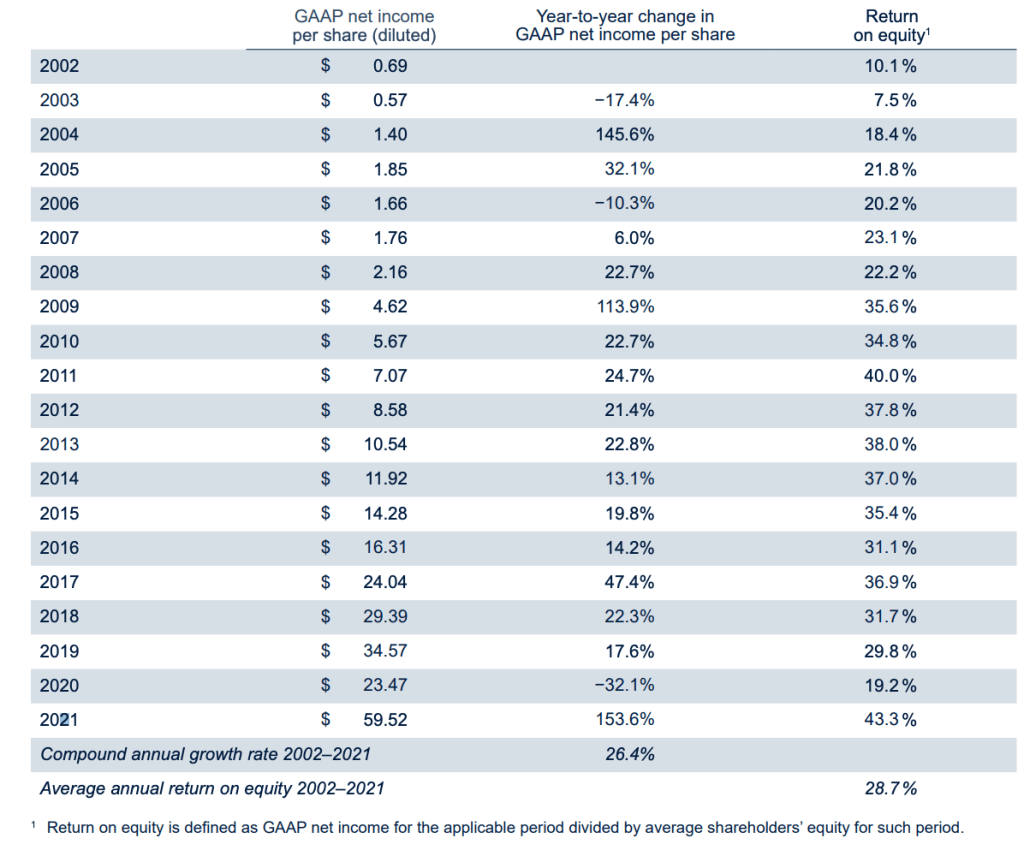
CACC’s 2021 Shareholder Letter

Credit Acceptance’s Runway

Over the past 20 years, Credit Acceptance has grown unit volume at a compounded annual rate of 9.3%. But in the past 3 years, unit volume has declined markedly. CACC already has 11,000+ dealers and with some sources estimating only 27,000 dealers in the country it will be a tough ask to expect more active dealer growth.
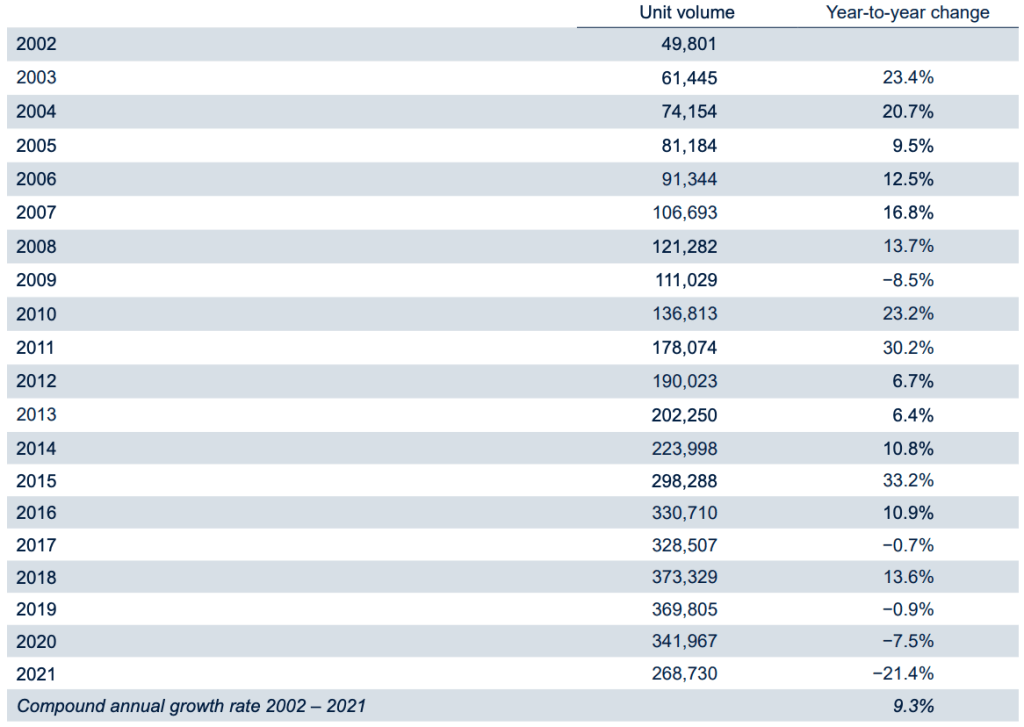
The past 3 years do show a potentially worrying slowdown in unit volume that could be indicative of CACC’s struggle to continuously find new dealers. Another possible explanation is the extremely loose monetary policy environment of the past couple of years. For the 3 months ended June 30, 2022, unit volume grew 5.1% vs 2021. However for the 6 months ended June 30, 2022, unit volume fell 10.5%. It is too soon to tell how the current change in interest rate policy will affect CACC but going off past cycles, there is reason to believe it will be a positive for the business. It seems that Credit Acceptance has no problem shredding some of its market share in competitive environments, knowing it will make it up when tighter monetary conditions emerge.

Business Risks

The 2 biggest risks Credit Acceptance faces are regulatory & default in my opinion. Starting with the latter, in 2021, 91% of unit consumer loans came from individuals with either no credit score or a FICO score below 650. It is difficult for many to accept a business only collecting 66.5% of their total loan value in a year.

CACC’S 2021 10K

The regulatory risk comes from moves to modify CACC by the Consumer Financial Protection Bureau (CFPR). Many individuals that defaulted on their loans have sighted CACC’s high interest rates and fees to be predatory. CACC claims that their business connects those that may never have got the chance at financing to dealers that also would’ve missed out on these consumers without them. There is some truth in this claim. However, it is very difficult to claim to be benign when you charge subprime borrowers 20-30% on loans. As the CFPR and other state attorneys clash heads with CACC, the business may incur material costs or be forced to change their business model.

Conclusion

In sum, Credit Acceptance is a company that has compounded earnings at a remarkably high rate for the past decades. The company to this day still continues to return great wealth to shareholders. For the 6 months ended June 30, 2022, CACC repurchased 8% of shares outstanding, the mark of a business with excellent economics. CACC does face the problem of having very few reinvestment opportunities as seen with the shrinking unit volume per dealer count. Credit Acceptance is a business with exceptional economics but may struggle to continue compounding at such high rates well into the future.

QE & Money Creation

Quantitative easing (QE) is a common form of unconventional monetary policy that is frequently referred to as money printing – incorrectly. QE does not involve the creation of notes and coins by central banks, which is still only a small portion of overall money supply. If QE is not money printing, then what is its purpose and is it directly inflationary? In this post, I’ll attempt to provide an explanation of what QE is and the process of money creation.

The Myth of the Money Multiplier

It is a very wide misconception that banks simply act as an intermediary lending out deposits made by other savers. In the modern economy, this is simply not true. Lending creates deposits, not the other way around. Private banks are the creators of deposit money and have no limit on their funds available to lend as long as they meet regulatory liquidity requirements. As private institutions, banks decide how much they wish to lend based on the profitability of available lending opportunities. Importantly, there is no money multiplier. The demand for loans from these banks rely heavily on the prevailing interest rate on these loans. While central banks do not control the amount of reserves, they can set the ‘price’ of reserves through interest rates.

The Process of QE:

Central banks’ preferred monetary policy tool is setting the interest rate (bank rate) on bank reserves in the overnight lending market. This should then effect a number of interest rates in the economy, such as bank loans. However, there is very little proof of this tool effecting longer-term interest rates in the economy and central banks run into a problem when the interest rate (bank rate) on these reserves are already near zero, while spending in the economy is not consistent with the central bank’s objective. The most common response is quantitative easing, which is just the central bank purchasing assets (ex: long-term government debt, mortgage backed securities) from mostly the non-bank financial sector (ex: insurance companies, pension funds). Since only commercial banks have reserve accounts at central banks, they are used as an intermediary in this transaction. In effect, when a central bank wishes to buy assets from a pension fund, the pension fund’s bank would credit its account by $x. The central bank would then credit the private bank’s reserve account (w/ equivalent $ amount) to finance the purchase.

Source

As shown by the image above, there is only a change of financial asset composition in the private sector, no new money was printed as a result of QE. The increase in commercial bank reserves at the central bank have no effect as they cannot be lended to consumers within the economy. Since QE initially increases the pension fund’s deposits, the fund is likely to deploy those deposits in higher-yield assets (ex: shares). Some argue that the asset swap performed by QE has little inflationary effect as the new deposits will only be used to buy assets in the financial sector and is not in the hands of consumers. Others argue that as a result of the central bank buying longer-term debt, the yields of these assets should fall along with longer-term interest rates. This then creates a favourable environment for lending to stimulate spending/investment within the economy

In sum, quantitative easing is not money printing, but an asset swap by the central bank to stimulate the economy. The increase of bank reserves does not directly go into the hands of the people in the economy as it is only to be used by actors with reserve accounts at the central bank. Although, central banks have enormous influence over the amount of money in the economy, there is no direct control of the monetary base. The majority of the money in circulation comes from commercial banks as opposed to printed by central banks. When the bank rate in the overnight market does hit its effective lower bound, it is appropriate for the central bank to begin an asset purchase program (QE) in the hopes of raising prices across the economy.

More Reading: https://www.researchaffiliates.com/publications/articles/364_whats_up_quantitative_easing_and_inflation#:~:text=When%20banks%20do%20not%20wish,therefore%20does%20not%20cause%20inflation.
https://www.bankofengland.co.uk/-/media/boe/files/quarterly-bulletin/2014/money-creation-in-the-modern-economy

An Immutable Formula

In the Berkshire Hathaway annual letter to shareholders for the year 2000, Warren Buffett credits Aesop (Greek fabulist) for laying out the formula in valuing assets in what would’ve been around 600 BC. The fable is as follows:

A Nightingale, sitting aloft upon an oak, was seen by a Hawk, who made a swoop down, and seized him. The Nightingale earnestly besought the Hawk to let him go, saying that he was not big enough to satisfy the hunger of a Hawk, who ought to pursue the larger birds. The Hawk said: “I should indeed have lost my senses if I should let go food ready to my hand, for the sake of pursuing birds which are not yet even within sight.”

A bird in the hand is worth two in the bush.

The formula when replacing birds with dollars has 3 essential questions an investor needs to answer. The 1st being how confident is the investor that the bush contains birds. The 2nd is a question of how many birds are there and when they will emerge. The 3rd and final question is to determine what the risk-free interest rate is. Essentially, investing is finding the present value of future cash flows and determining if it is sensible at present interest rates to outlay the cash now. This formula on determining the value of an asset is immutable. No new inventions now or far into the future will change the formula one bit. All that needs to be done is plugging in the correct numbers (far easier said than done) in the formula and one can begin rank the attractiveness of different assets.

Buffett also warns that common yardsticks like dividend yield, the ratio of price to earnings or book value, and growth rates don’t inform you on the valuation of a business but instead should be used as clues for the amount and timing of cash flows in and out of the business. For example, if someone pays an amount of cash on the promise of future growth that exceeds the discounted value of cash that assets will generate in later years this will lead to a poor return on investment. This shows that the price paid directly affects the return on investment. Growth is a component in the equation of finding value that is usually a positive but can be a minus. Growth & value should not be looked at as two competing investment styles as they are joined at the hip.

Another important element to the formula to consider is the difficulty of predicting when and how many dollars (or birds) will come out of the business (or bush). It is better for the investor to remember the words of Keynes in this regard: “Better roughly right than precisely wrong”. It is better to consider ranges than exact figures. On some occasions the very conservative estimate may see a price quotation very cheap in relation to its value. If this condition can be met the investor can then realize a margin of safety and make an investment decision. To reach such a conclusion an investor should understand the business economics of the companies in question.

Most of the time, it will be difficult for the investor to come up with a logical conclusion on the number of birds inside the bush even with broad estimates. This occurs when the looking at newer businesses and rapidly changing industries. An investor should try their best to remain in their circle of competence – even then there will be mistakes to come. It is best for the investor to stay away and avoid any speculative capital commitment.

Over the long term, many businesses will continue to uncover their birds in the bush and create immense value. But for the businesses that lose money over their lifetime, value can only be destroyed and not created regardless of how high their valuations may rise in the short term.

Table of Contents

“The act of writing, it seems to me, makes up a shelter, allows space to what would otherwise be hidden.” – Meena Alexander

I will let this page serve as a place to find all written work on this blog organized from most to least recent:

The Makeup of Banks

A Clean Bill of Health

Thinking Like An Activist (& Fixed Income Analyst)

Revisiting & Assessing Gogo

Swiping Right – Match Group

Couche-Tard Pitch

My Investment Journey

Variant Perceptions

Turbulent Valuations – Gogo Pitch

Managerial Case Study – Tom Murphy

Understanding Multiples

Operating Leverage & Margins

TSMC Pitch

Railroad Industry Primer

Emirates Driving Company Pitch

Discounting & M.O.S

Google Pitch

Share Repurchases & The Shareholder

BV v. IV

Importance of Returns on Capital

Activision Arbitrage?

Inflation & Equity Returns

Adobe Economics

Credit Acceptance Economics

Google Economics

QE & Money Creation

Europe’s Energy Crisis

EM Crisis (1) EM Crisis (2)

An Immutable Formula

Table of Contents

I will let this page serve as a place to find all written work on this blog organized from most to least recent:

Thinking about Trash

The Makeup of a Bank

Google’s 1Q25 Earnings

Thinking Like An Activist

Revisiting & Assessing Gogo

Swiping Right – Match Group

Couche-Tard Pitch

My Investment Journey

Variant Perceptions

Turbulent Valuations – Gogo Pitch

Managerial Case Study – Tom Murphy

Understanding Multiples

Operating Leverage & Margins

TSMC Pitch

Railroad Industry Primer

Emirates Driving Company Pitch

Discounting & M.O.S

Google Pitch

Share Repurchases & The Shareholder

BV v. IV

Importance of Returns on Capital

Activision Arbitrage?

Inflation & Equity Returns

Adobe Economics

Credit Acceptance Economics

Google Economics

QE & Money Creation

Europe’s Energy Crisis

EM Crisis (1) EM Crisis (2)

An Immutable Formula